


The Scenario That Keeps Operations Managers Awake
Picture this: A customer orders concrete for a commercial pour. Your sales team takes the details and enters them into your POS system. Someone from production manually re-types the same information into your batching system. Another team member updates the delivery schedule in your fleet management software. Eventually, someone remembers to update accounting.
Somewhere between those handoffs, a detail changes. Maybe it’s the mix specification. Maybe it’s the delivery time. Maybe it’s the volume required.
The truck arrives on site with the wrong product. Work stops. The pour is delayed. Your customer is furious. Your team scrambles to fix it. And what should have been a straightforward job becomes a costly exercise in damage control.
If this sounds familiar, you are not alone.
The Real Cost of Disconnected Systems
Australia’s concrete industry is substantial, valued at $3.4 billion in 2025 according to IBISWorld. Yet nearly 60% of concrete companies have experienced significant supply chain management issues in recent years, with many facing operational challenges that directly impact their bottom line.
Here’s what manual processes and disconnected systems are actually costing your operation:
- Time Vanishing Into Administrative Tasks
Your team enters the same data multiple times across different systems. Every order becomes a repetitive exercise in data entry; once for sales, again for batching, again for dispatch, and again for accounting. Those hours add up quickly.
- Errors That Multiply Across Handoffs
Each manual transfer is an opportunity for mistakes. A misread specification. A transposed number. A missed update. These aren’t just administrative hiccups, they are operational disruptions that cascade through your entire process.
- Operations Running Blind
Without integrated systems, you are managing by guesswork rather than data. Which trucks are underutilised? Where are the bottlenecks? Which jobs are actually profitable? If you can’t see it in real time, you can’t manage it effectively.
- Revenue Left on the Table
The Australian construction sector reached $76.1 billion in activity in Q4 2024, representing massive opportunity. But when your fleet sits idle or makes inefficient runs because dispatch lacks real time visibility, you are missing out on that growth.
What Modern Integration Actually Means
Let’s clear up a common misconception: integration doesn’t mean ripping everything out and starting from scratch.
Modern integration connects your existing systems, making them communicate with each other in real time. Companies that have embraced this approach report 20-30% increases in efficiency across their operations.
Here’s what that looks like in practice:
- Single Point of Data Entry
Order details entered once flow automatically to batching, fleet management, and accounting. No re-keying. No transcription errors. No information gaps.
- Real-Time Operational Visibility
Operations managers see live updates on plant capacity, truck locations, and delivery schedules in one unified view. Make decisions based on what’s happening right now, not yesterday’s paperwork.
- Automated Workflows
From quote to invoice, processes that once required multiple touchpoints happen automatically – faster, more accurately, every single time.
Your Modernisation Roadmap: Where to Start
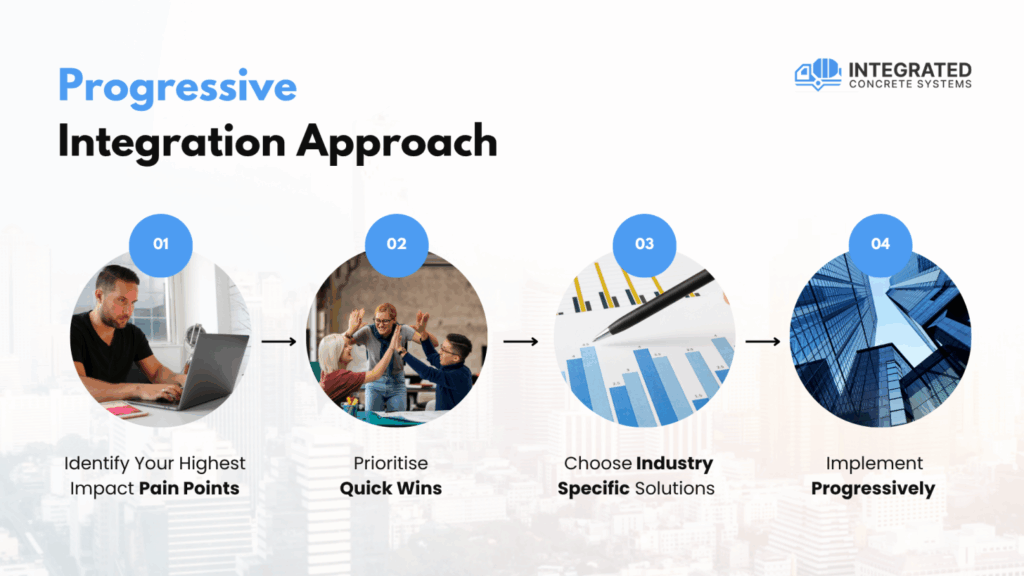
Thinking about modernising your operations? Here’s a practical approach that won’t disrupt what’s already working:
- Step 1: Identify Your Highest Impact Pain Points
- Step 2: Prioritise Quick Wins
- Step 3: Choose Industry Specific Solutions
- Step 4: Implement Progressively
Technology Selection: What Actually Matters
When evaluating integration solutions, focus on these critical factors:
- Industry Specific Expertise – Generic software won’t understand the nuances of concrete operations. You need solutions built by people who know your industry inside out.
- Non-Disruptive Integration – Can it connect to your existing systems without forcing wholesale replacement? The right answer is yes.
- Real-Time Data Flow – Batch updates at the end of day aren’t sufficient. You need live, bidirectional communication between all systems.
- Scalability – Will it grow with your business? Today you might have five trucks. Tomorrow, fifty. Your systems should handle both scenarios equally well.
- Comprehensive Support – Technology is only as effective as your team’s ability to use it. Strong implementation support and ongoing training aren’t optional extras – they’re essential.
The Australian Context
With the Australian construction industry facing unprecedented challenges from cost inflation, material delays, and labour shortages, the concrete sector can’t afford to operate on outdated manual processes.
BuildSkills Australia reported that 90,000 new tradespeople would be needed, yet skilled workers remain scarce. When you can’t simply add more people to solve operational challenges, you must work smarter with the resources you have.
Integration isn’t about chasing technology trends. It’s about fundamentally changing how your operation runs: fewer errors, faster processing, better visibility, and higher profitability.
Ready to Discover Where Integration Could Transform Your Operations?
We are offering a complimentary 1-Hour Systems Modernisation Assessment, a comprehensive evaluation of your current processes to identify exactly where integration could eliminate errors and unlock efficiency.
No sales pressure. Just actionable insights you can implement whether you work with us or not.
Uncover your efficiency opportunities → link
What’s the biggest operational challenge you’re facing in your concrete business right now? Share in the comments below – I read every response and often share insights from these conversations.
Related Posts

March 12, 2026
Beyond Spreadsheets: Why Modern Concrete Operations Demand Integrated Solutions
Surfing through spreadsheets is a Broken Link that Costs Your Growth! Consider a typical morning…

November 24, 2025
Leveraging Data Analytics for Smarter Concrete Operations
In the concrete industry, success isn’t just about strong materials — it’s about strong decisions.From…
November 7, 2025
Reducing Errors in Concrete Batching: Best Practices for Modern Businesses
Concrete production is a high-stakes process where precision matters. A single batching error—whether in mix…

October 27, 2025
How an All-in-One Solution Can Reduce Costs and Boost Productivity in Concrete Operations
In the concrete industry, efficiency is everything.But for many businesses, operations still rely on multiple…